Disclosure: this post contains affiliate links. If you click our link and get a policy, we may earn a commission at no extra cost to you — it helps keep our tutorials and tools free.
“I’m too small to need insurance.”
We hear some version of this from makers all the time. You pour in your kitchen. You sell at a few craft fairs and on Etsy. It’s a side hustle, not a corporation — why would you need business insurance?
Here’s the uncomfortable truth: the smaller you are, the less you can afford a single bad day. One customer claiming your candle damaged their furniture, one market organizer asking for proof of coverage you don’t have, one fire blamed on a product you poured — any of these can end a small business overnight. Insurance is how you make sure a bad day stays a bad day instead of becoming the end.
This isn’t legal advice — we’re candle makers, not insurance agents, and you should talk to a licensed professional about your specific situation (our full disclaimer applies). But after digging into what insurers actually offer makers, here are the reasons every candle business should take this seriously.

1. Your homeowners or renters insurance almost certainly doesn’t cover your business
This is the big one, and the most misunderstood. A standard homeowners or renters policy is written for your personal life — not for the business running out of your spare room. Multiple insurance sources agree: business activity, business inventory, and business liability are typically excluded.
That means the shelves of fragrance oil, the cases of wax, the finished candles stacked for your next market — your home policy likely won’t replace them if they’re stolen or destroyed. And if a customer comes to pick up an order and gets hurt at your home, or a product you made causes damage, don’t expect your homeowners policy to step in. One insurer’s own example is literally a candlemaker facing a product liability claim over furniture allegedly ruined by a candle — exactly the scenario a home policy won’t touch.
2. Craft fairs, farmers markets, and pop-ups often require it
Want to sell at a good market? Many organizers require vendors to carry liability insurance and show a certificate of insurance (COI) as proof before they’ll give you a booth. Some venues go further and ask to be added as an additional insured on your policy.
This isn’t rare or new — it’s standard practice at established fairs, farmers markets, and holiday markets. No certificate, no booth. If you’ve ever been turned away from a market you wanted into, this might have been why.

3. If your product ever causes harm, it’s on you personally
Candles are fire. That sounds obvious, but think about what it means legally: if a customer claims your candle caused a fire or damaged their property, the claim comes to you — not your supplier, not the fragrance company. Without product liability coverage (sometimes called products-completed operations), you’re paying for lawyers and damages out of pocket.
The Handcrafted Soap & Cosmetic Guild puts it bluntly: product liability is the only type of insurance that covers you if someone gets injured using your products. Their example? “A house fire is blamed on your candle.” That’s the scenario you’re insuring against.
4. Wholesale buyers and platforms expect it
Selling wholesale? Brick-and-mortar retailers commonly require proof of liability insurance before they’ll stock your products. And the big platforms are explicit: Amazon requires sellers to carry $1 million in general and product liability coverage, list Amazon as an additional insured, and provide a valid certificate of insurance.
If wholesale is anywhere in your plans — and if you read our Faire wholesale guide, it probably is — insurance isn’t optional. It’s part of looking like a real business to buyers.
5. Adding things to your wax? Read this twice
Dried flowers, herbs, crystals, glitter, coffee beans — decorative embeds look beautiful in photos, and customers love them. But here’s what you need to know: the National Candle Association had botanical-embedded candles tested at an independent lab following ASTM candle fire-safety procedures. They reported safety failures in every case — multiple large flames with the potential to start a home fire. The NCA urges consumers not to light them at all.
What does that mean for insurance? No major U.S. insurer we’ve found publishes an explicit exclusion for embedded objects — but embeds are a documented, lab-tested fire hazard, and insurers price risk. Some standard “maker” policies exclude candles entirely. The safe move: tell your insurer exactly what you put in your candles and get written confirmation that your policy covers those products. If you make embedded candles, this conversation isn’t optional.
(And for the record: our own tutorials never show flammable embeds in burning candles, for exactly this reason.)
6. It costs less than you think
This surprises most makers. Published figures from insurers and brokers put general liability for a small home-based business in the range of roughly $20–$50 per month, with maker-specific annual programs advertised from a few hundred dollars a year. Insurer “starting at” prices are marketing — your actual premium is individually underwritten — but the ballpark is real: this isn’t a thousand-dollar problem for most small makers. It’s the cost of a couple of candle sales a month to protect everything you’ve built.
What to look for in a policy
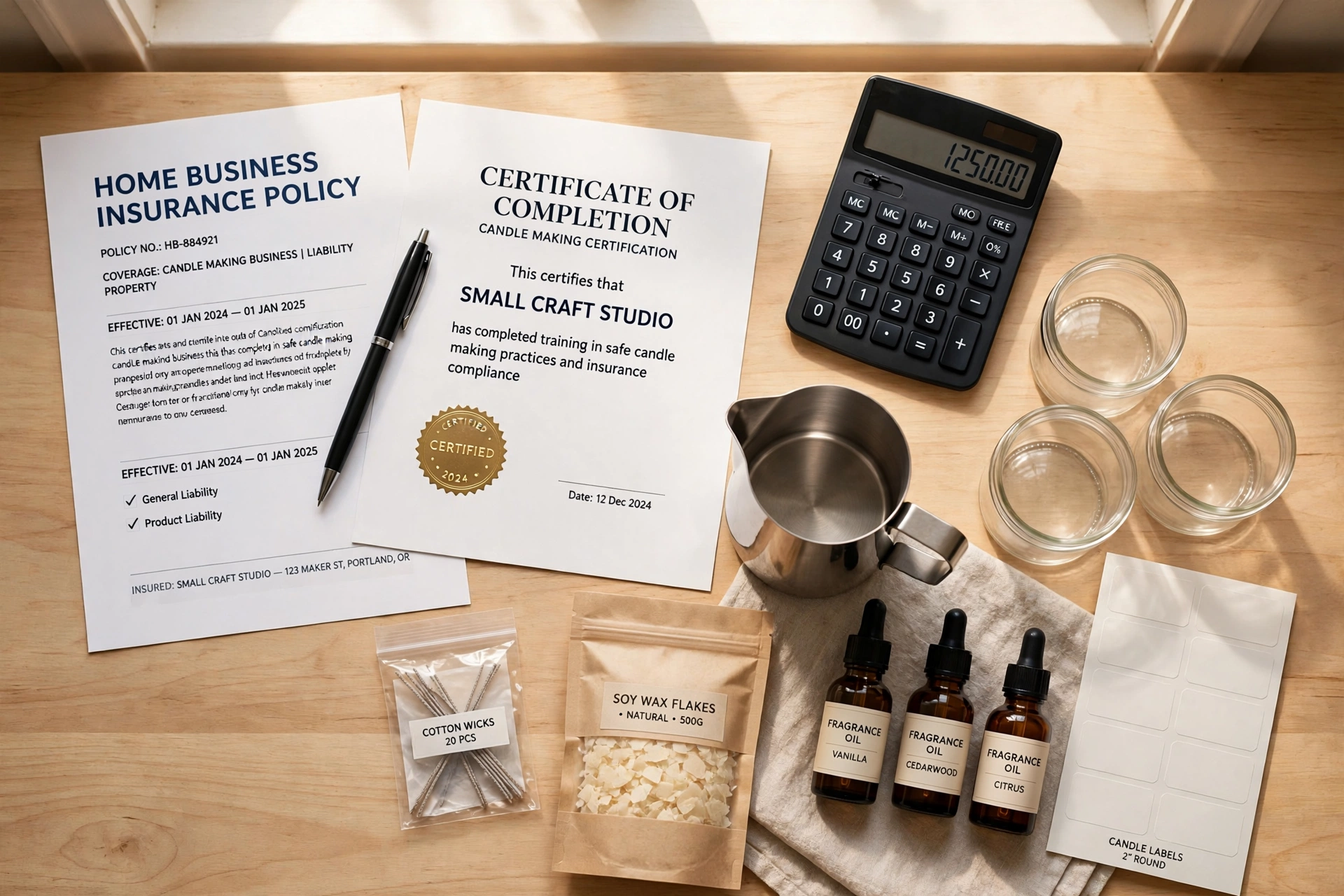
If you start shopping, here’s the checklist that matters for a candle business:
- General liability — covers injuries and property damage from your business operations (someone trips at your market booth, for example).
- Product liability / products-completed operations — covers claims that your product caused injury or damage after it was sold. This is the big one for makers. Confirm it’s actually included — check the declarations page, not just the marketing.
- Commercial property — covers your inventory, wax, oils, and equipment. A business owner’s policy (BOP) bundles this with general liability, and some can be written for a home-based business.
- Certificates of insurance — you want unlimited, instant COIs with the ability to add venues as additional insured. You’ll need these constantly for markets.
Where makers actually get covered
There are programs built specifically for handmade businesses — ACT’s Pro policy for handmade beauty businesses, the Handcrafted Soap & Cosmetic Guild’s member insurance, the Indie Business Network — all advertised in the few-hundred-dollars-a-year range with product liability included. Worth comparing.

For a general small-business carrier with a candle-specific offering, NEXT Insurance (now ERGO NEXT) is the one we’d look at first. They’re a licensed carrier (AM Best A+ rating) writing policies in all 50 states, they have a dedicated candle-store insurance page, and their general liability includes product liability coverage for handmade candles, wax melts, fragrance oils, and kits — plus commercial property for your inventory and equipment, and instant certificates of insurance for markets. They explicitly market to home-based businesses, which is exactly what most of us are. Getting a quote takes about ten minutes.
The bottom line
Nobody buys insurance because it’s fun. You buy it so that one bad day — a market requirement, a customer claim, a ruined batch of inventory — doesn’t become the reason you stop making candles. If you’re selling anything to anyone, you’re big enough to need it.