Your candles are selling, a boutique wants to carry them, and someone mentions Faire. Here’s what the wholesale marketplace actually is, what it costs, and how candle makers handle the shipping and marketing side as orders grow.
Affiliate disclosure: this tutorial contains an affiliate link to Faire. If you sign up through our link, we may earn a commission at no extra cost to you — it helps keep our tutorials free.

What Faire Is (and Isn’t)
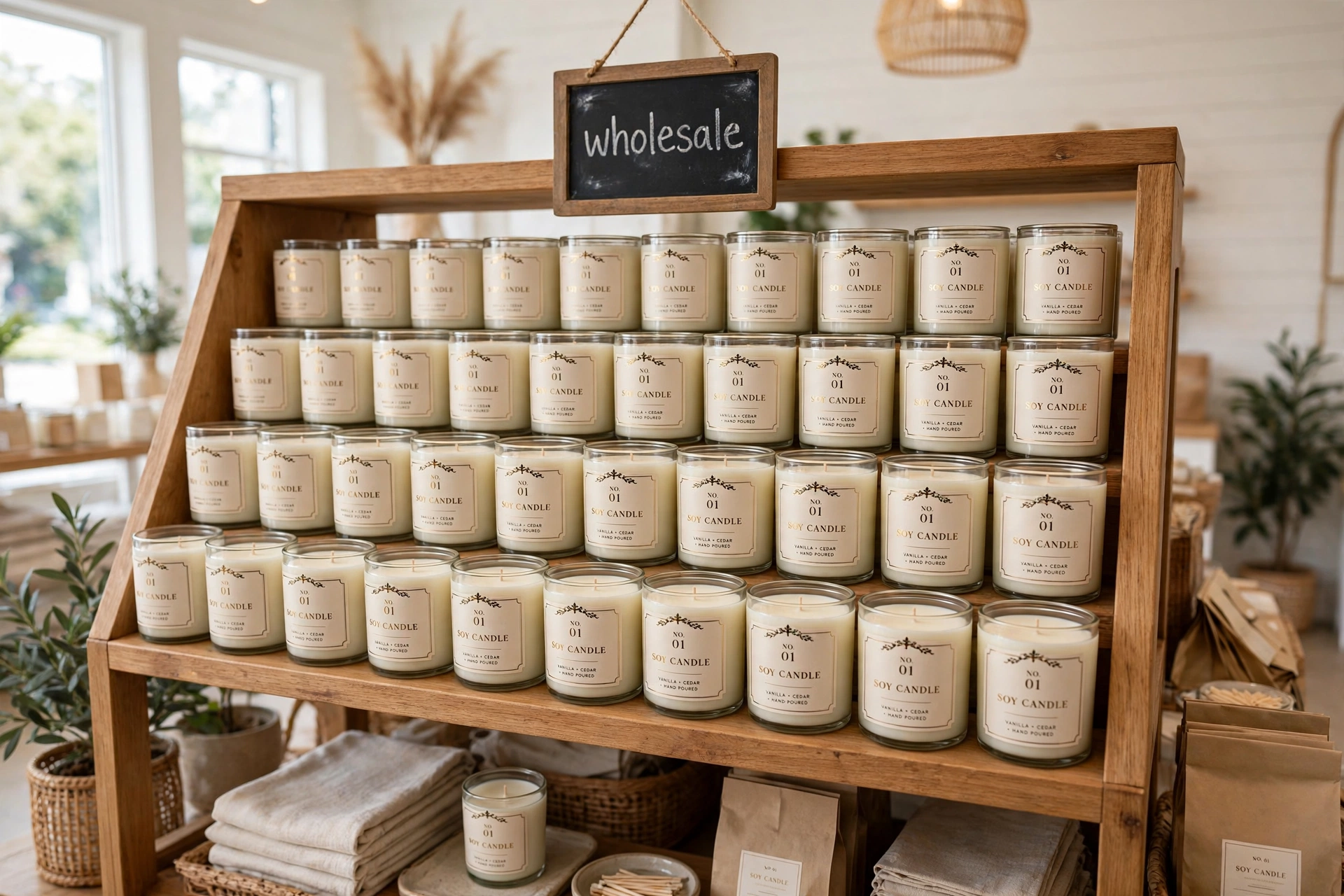
Faire is an online wholesale marketplace. Instead of selling one candle at a time to shoppers, you list your products at wholesale prices and retail stores — gift shops, boutiques, spas, bookstores — order from you in bulk to resell on their shelves.
Think of it as a trade show that never closes. Retailers browse thousands of brands, place orders online, and Faire handles the payment side. You make the candles and ship the orders.
What it isn’t: a place to sell single candles to the public (that’s Etsy, your website, or a craft market), and it isn’t passive income. Wholesale buyers expect professional packaging, reliable lead times, and consistent product — the same things a local boutique would expect if they stocked your line.
Is Faire Right for Your Candle Business?
Faire makes the most sense when a few things are true:
- You can produce in volume. Wholesale orders are typically dozens of units at a time, not ones and twos. If a 48-candle order would wreck your week, build up production capacity first.
- Your margins survive wholesale. Wholesale usually means selling at roughly half your retail price — and then Faire takes its cut on top (more on fees below). Run the math before you list a single product.
- Your branding looks retail-ready. Labels, lids, boxes — a buyer is putting your candle on a shelf next to established brands. If your packaging still looks homemade, fix that first.
- You actually want wholesale. Some makers love the craft-market hustle and don’t want the production treadmill. That’s fine — Faire is a choice, not a requirement.
What Faire Costs Sellers
There’s no monthly fee to sell on Faire — you only pay when orders come in. Here’s the fee picture as of 2026 (always double-check Faire’s current terms, since they evolve):
- Commission on marketplace orders: around 15% of the product subtotal when a retailer discovers you through Faire’s marketplace. This applies to first orders and reorders from Faire-sourced retailers.
- New-retailer fee: a one-time $10 fee on a retailer’s very first order with you.
- Payment processing: roughly 2–3.5% plus about $0.30 per order, depending on payout speed.
- Faire Direct — 0% commission: if a retailer comes through your own personal Faire link (say, a boutique you already sell to), you pay no commission at all on their orders — just processing. This is a big deal if you have existing wholesale relationships to move onto the platform.
Do the math before you list. Example: a candle that retails for $28 wholesales around $14. On a $140 retailer order (10 candles), Faire’s cut runs roughly $21 in commission plus $10 on a first order, plus a few dollars in processing. Know your true cost per candle — wax, fragrance, vessel, wick, label, labor, packaging — and make sure the wholesale price still leaves you real profit after fees. Price for the fees; don’t absorb them and hope.
One more money note: Faire offers retailers net-60 payment terms (they can pay up to 60 days later), but you get paid within a few business days of the order shipping. Faire carries the credit risk, not you — which is exactly why retailers are willing to try a brand they’ve never bought from.
Getting Set Up and Approved
Selling on Faire requires an application — they verify that you’re a legitimate brand and that retailers are legitimate businesses. The application asks about your products, pricing, and business details. You can start your free Faire application here through our link.
What helps you get approved and get found:
- Wholesale pricing with minimums. Set a minimum order amount (common: $100–$300 for candle lines). Minimums keep tiny orders from eating your week.
- Clean product listings. Every scent gets its own listing with a clear name, wholesale price, case-pack options, and burn time.
- Photography that sells to a buyer, not a scroller. Crisp product shots on clean backgrounds plus one lifestyle image showing the candle in a styled space. Buyers are imagining it on their shelf.
- Honest lead times. If you need 7–10 business days to pour and cure before shipping, say so. Late wholesale shipments kill reorders faster than anything.
Shipping, Start to Finish
Setting up your shipping settings comes before your first order lands — and it’s where most makers quietly lose money.
Weigh your products accurately. Your listings feed Faire’s shipping calculations, so weigh each finished, packaged candle — not the pour weight, the shippable weight. Then weigh your standard packed case sizes. Candles are dense; a small box can weigh a lot, and guessing low means you eat the difference.
Two ways to buy labels. One, Faire’s shipping program: buy discounted labels right in the brand portal and the cost goes on the retailer’s invoice automatically. Two, your own carrier: buy the label yourself, then enter the actual shipping cost in the portal when you mark the order shipped — Faire adds it to the invoice and reimburses you on payout day. Either way the retailer pays the shipping; you just pick whose rates you like.
Set a lead time you can actually hit. The portal shows the retailer an estimated ship date based on your processing time. Under-promise and beat it — late wholesale shipments kill reorders faster than anything.
Faire Insider is optional. It’s a retailer subscription that includes free shipping from partner brands. If you join as a partner, Faire covers shipping on marketplace orders; you only cover it on zero-commission Faire Direct orders. Nice for volume, not required.
Don’t panic at free-shipping promos. Faire sometimes gives new retailer accounts free shipping — that’s Faire’s promotion and Faire covers it, not you.
When an order comes in, here is the full process:
1. Accept the order. You’ll get an email the moment a retailer checks out. Open the brand portal, review the order, and accept it — you can also set the ship date, put an item on backorder, or cancel if you truly can’t fill it. Don’t sit on it; the clock starts now.
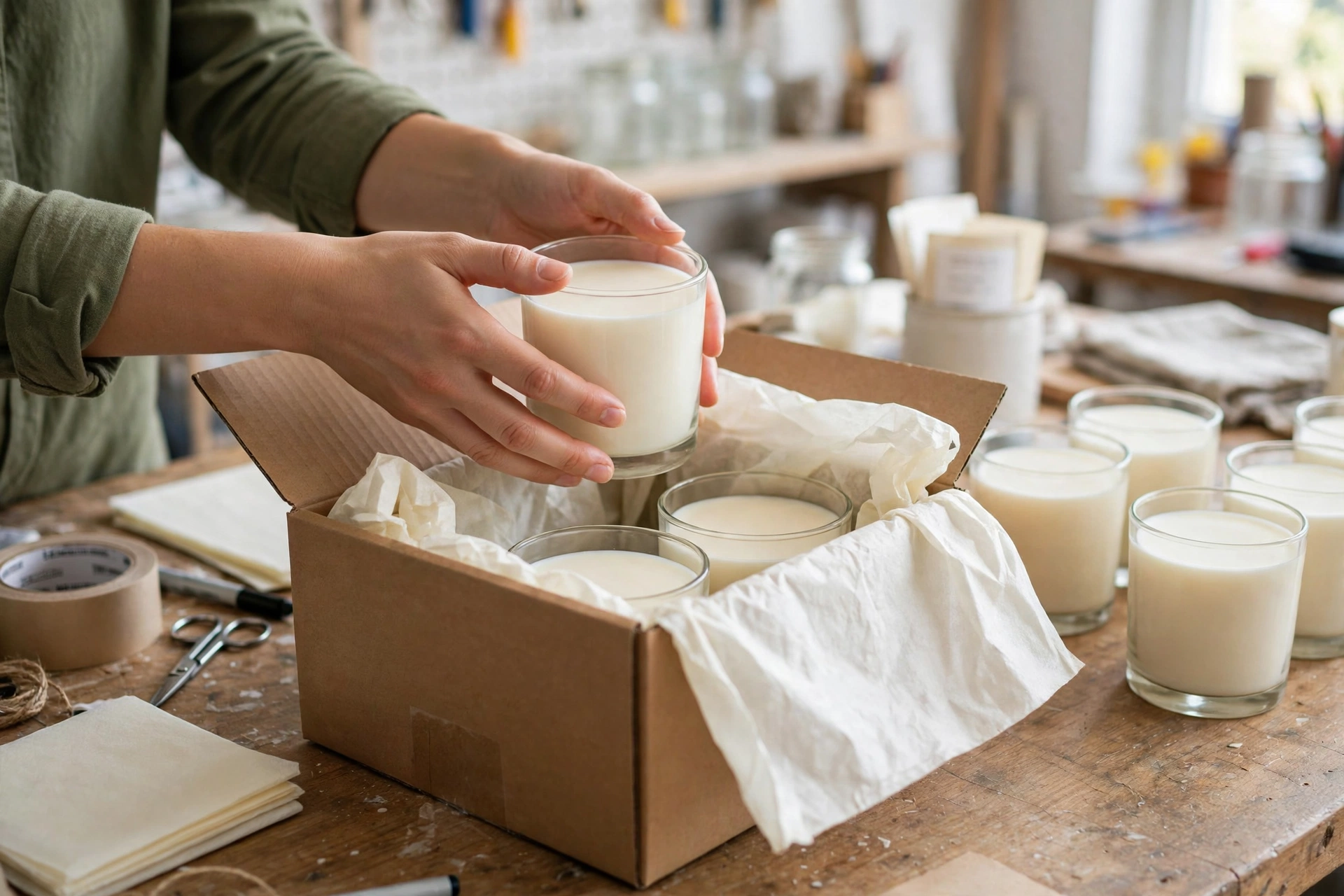
2. Pack it retail-ready. The retailer should be able to put your candles straight on the shelf — lids on, labels straight, no repacking on their end. Double-box: inner box with dividers or snug padding around each unit, then that box inside a sturdy outer shipping box with cushioning. Glass vessels plus heavy wax are the number-one damage risk in wholesale candle shipping. The padding feels expensive until you price a reshipment.
3. Know what goes in the box. The packing slip (the portal generates it), a business card, and a short thank-you note or line sheet showing your other scents — reorders come from retailers discovering what else you make. A sample of a new scent is a nice touch when it makes sense.
4. Label it and ship it. Buy the label through Faire’s discounted program or your own carrier account, stick it on, and drop it off or schedule a pickup.
5. Mark it shipped. In the portal, enter the tracking number and the shipping cost. Faire emails the tracking link to the retailer automatically, and your payout — products plus shipping — settles on your normal payout schedule.
6. Talk through the portal, not email. All retailer communication happens in Faire’s internal messaging — you won’t get the retailer’s email address, and that’s by design. You will see their delivery address so you can ship the order. If anything needs clarifying, message them in the portal and keep it there.
Too Heavy for One Box? Split the Shipment.
Here is a question that comes up once orders get big: an order for 40 candles arrives, and putting them all in one box feels wrong. Trust that instinct — split it. A filled 8-ounce jar weighs close to a pound, so 40 candles plus packaging puts roughly 40 pounds of glass in a single box. That is usually still under carrier weight limits, so the problem is not the limit — it is breakage and handling. A heavy box gets dropped harder, stacked under heavier freight, and is miserable for the retailer to lift. Two lighter boxes travel safer than one back-breaking one.
Nothing in Faire’s fulfillment flow requires an order to ship in a single box. The flow is built around packages: you create a label per package, and multi-parcel orders are a normal part of wholesale shipping. So split the order and treat each box as its own shipment:
- Balance the weight. Split 40 candles into two boxes of 20 rather than one heavy box and one light one. Even weight means even handling.
- Pack each box to the same standard. Every box gets the full retail-ready treatment from step 2 above: lids on, labels straight, dividers or snug padding, double-boxed. Don’t let the second box be an afterthought — it arrives at the same store.
- Put a packing slip in each box. The portal generates the packing slip, so print a copy for each box. That way either box can be checked in on its own if they arrive on different days.
- Label each box separately. If you use Ship with Faire, create a label for each package. If you ship on your own carrier account, buy a label per box.
- Enter the combined shipping cost. When you mark the order shipped, enter the total shipping cost for both boxes, not just the first. Your payout is products plus the shipping cost you enter, so entering only one box means eating the second box’s postage.
- Make sure both boxes are tracked. Enter the tracking numbers in the portal. If the portal only takes one tracking number, enter the first and message the retailer the second one through the portal — all retailer communication stays in the portal, and the retailer needs to be able to track both boxes.
- Tell the retailer to expect two boxes. A short portal message — “Your order is shipping in two boxes, tracking numbers X and Y” — keeps a partial delivery from looking like a missing shipment. If one box arrives a day before the other, that’s normal, not a problem.
That is all there is to it. Splitting doesn’t change your payout schedule or how Faire treats the order — it just gets heavy glass to the retailer in one piece.
Keep bestsellers poured ahead. Don’t pour to order one retailer at a time. When orders climb, pour in batches by scent, keep finished-goods inventory of your bestsellers, and reorder vessels and wax before you run out — not after. An accepted order you can’t fill on time is worse than no order at all.
Marketing on Faire (Yes, You Still Have to Market)
Listing products isn’t enough — thousands of brands are on Faire. The makers who do well treat it as a sales channel, not a lottery ticket:
- Use your Faire Direct link everywhere. Put it in your email signature, your wholesale page, your Instagram bio. Every retailer who orders through your link costs you 0% commission instead of ~15%. That’s the single highest-leverage move on the platform.
- Invite your existing stockists. Already selling wholesale to a few local shops? Move them onto Faire through your Direct link. Easier reordering for them, zero commission for you.
- Collect reviews. Retailer reviews are social proof for the next buyer browsing your line. A short thank-you note in each shipment asking for honest feedback goes a long way.
- Run promos strategically. Faire lets you offer discounts — use them around trade-show seasons or to move a slow scent, not as a permanent crutch.
- Samples convert. Many successful sellers offer sample packs. A $20 sample set that lands a $500 opening order is cheap customer acquisition.
- Keep your catalog fresh. New scents and seasonal collections give past buyers a reason to come back and reorder.
When Orders Start Climbing: Growing Pains to Plan For
The member question that started this tutorial mentioned increasing orders — congratulations, and here’s what to watch as wholesale grows:
- Inventory discipline. Nothing kills momentum like accepting an order you can’t fill. Keep a simple finished-goods count and set reorder points for vessels, wax, and fragrance oil based on your actual sales pace.
- Cure time is real. Soy candles need their cure before they burn their best. Build cure time into your lead times — don’t ship a candle poured yesterday to hit a deadline.
- Customer service is the product. A damaged case replaced same-day, a tracking number sent proactively, a quick answer to “do you do custom labels?” — this is what turns a first order into a standing reorder.
- Know when it’s too much. If Faire orders are crowding out the parts of the business you actually enjoy, it’s okay to raise minimums, pause new listings, or step back. Wholesale should serve your business, not swallow it.
Where Candle Makers Talk Faire
As for the original question — is there a group or resource specifically for candle makers on Faire? There isn’t one big dedicated hub that we know of, but you don’t need one: wholesale questions come up regularly right here in our community, from pricing math to packing a 200-unit order without losing your mind. Ask away — chances are another member has already solved exactly what you’re stuck on.
Get candle-making tips by email
Join the list for new tutorials, tools, and supplier deals — straight to your inbox.
Signed up between Oct 7 and Oct 28 and never heard from us? We fixed a glitch that was dropping signups — please sign up again!