Candle making has its own language, and tutorials assume you already know it. Melt pool, hot throw, mushrooming, wet spots — every one of these means something specific, and knowing the words makes every other tutorial easier to follow. This glossary defines the terms a beginner meets first, in plain language, in the order you are likely to meet them.
Burning Terms
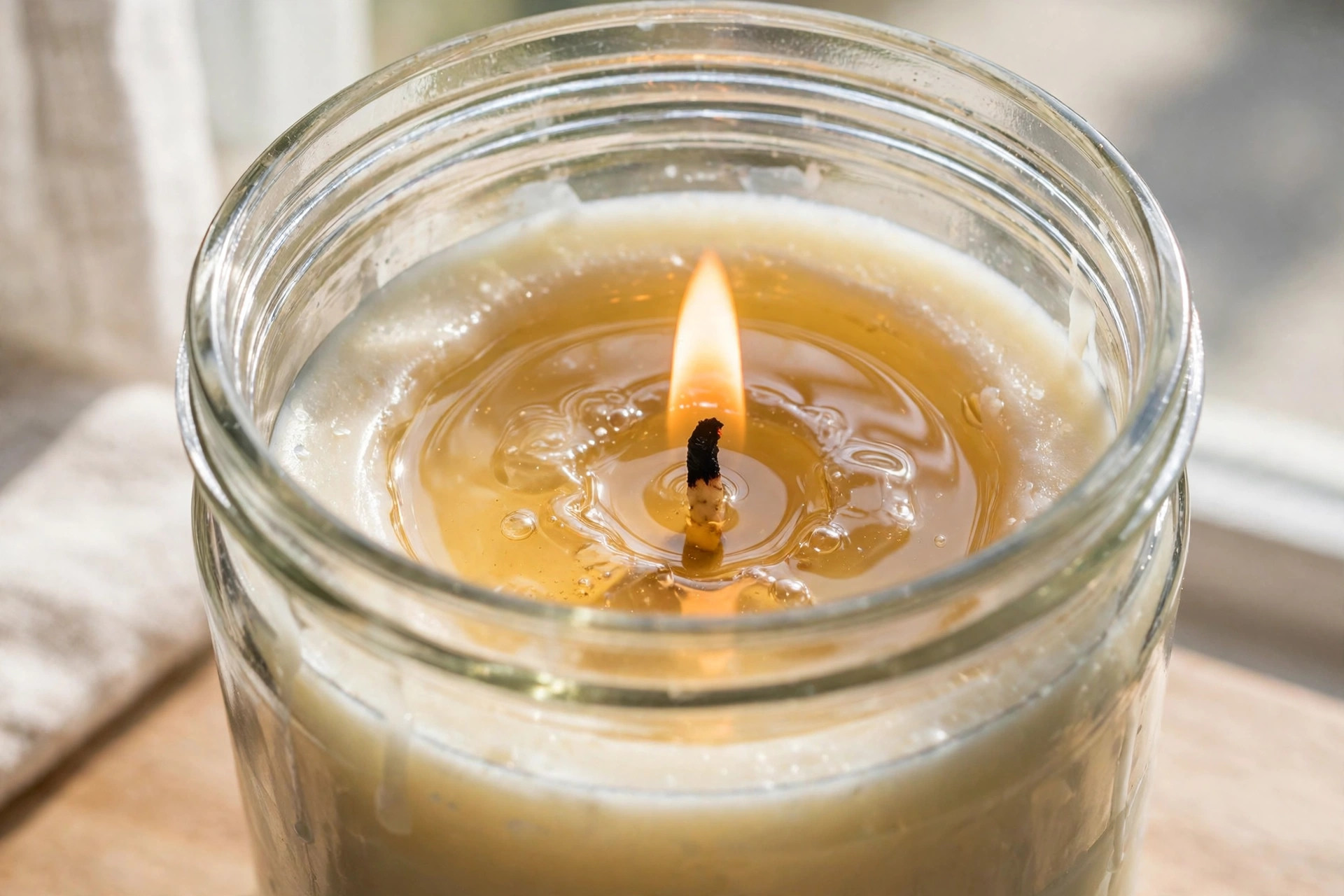
Melt pool. The pool of liquid wax that forms around the wick while a candle burns. A good melt pool reaches the edges of the container. The melt pool is what feeds the flame and releases fragrance into the room.
Full melt pool. A melt pool that stretches all the way to the edges of the container. Reaching a full melt pool on the first burn is the main defense against tunneling.
Hot throw. How strongly a burning candle scents a room. A candle can smell strong in the jar and weak when lit, or the reverse — hot throw is the burning test, and it is the one that matters.
Cold throw. How strongly an unlit candle smells, sniffed at the jar or held close. Cold throw tells you the fragrance is in the wax, but it does not guarantee hot throw.
Tunneling. When a candle burns a narrow hole down the middle and leaves a ring of unmelted wax around the edges. Tunneling is usually caused by short first burns, a wick that is too small, or both. Once a tunnel forms, it tends to continue, because the flame keeps following the same narrow path.
Mushrooming. A bulb of carbon that builds up on the end of the wick, shaped a little like a mushroom. Mushrooming comes from a wick that is too large, a wick that is too long, or fragrance that the wick cannot burn cleanly. Trim the wick to one quarter inch before every burn to keep it in check.
Sooting. Black soot on the container, the walls, or in the air, caused by a flame burning too large or too dirty — usually a wick that is too long or too large, or a candle burning in a draft.
Wax and Surface Terms
Frosting. A white crystalline pattern that forms on the surface of soy candles (and sometimes on the sides). Frosting is cosmetic only and does not affect how the candle burns. It is a natural feature of soy wax, not a defect.
Wet spots. Patches where the wax has pulled away from the inside of a glass container, looking like small damp marks. Wet spots are cosmetic, caused by cooling conditions or a cold container, and do not affect the burn.
Sinkholes. Dips or holes that form in the top of a candle as the wax cools and contracts, sometimes with a hollow pocket underneath near the wick. Sinkholes are usually caused by pouring too hot or cooling too fast, and they are fixed with a thin second pour at pouring temperature.
Curing. The resting period after pouring during which the wax and fragrance bind together and the scent develops fully. Candles should cure for at least 48 hours before a test burn, and soy scent keeps improving for up to two weeks.
Fragrance load. The amount of fragrance oil in a candle, expressed as a percentage of the wax weight. One ounce of fragrance per pound of wax is about 6 percent. Every wax and every oil has a maximum load — never exceed either one.
Flash point. The temperature at which a material’s vapors can ignite if they meet a flame. For most candle waxes this is above 300 degrees Fahrenheit, far above normal pouring temperatures — which is why overheating wax is dangerous and why a thermometer is not optional.
Wick and Making Terms
Wick tab. The small metal disc at the bottom of a wick that anchors it to the container and keeps the flame from reaching the bottom of the candle.
Wick sticker. A small adhesive disc that fixes the wick tab to the bottom of the container so it stays centered during the pour.
Centering device. A bar, frame, or holder that sits across the top of a container and keeps the wick straight and centered while the wax sets.
Double boiler. A setup for melting wax safely: a heat-safe pouring pitcher set inside a larger pot of simmering water, so the wax is never directly on a burner.
Pouring temperature. The temperature at which melted wax is poured into its container, set by the wax’s product sheet. Pouring too hot causes sinkholes and frosting; pouring too cool makes lumpy wax that does not grip the container.
Test burn. Burning a finished candle yourself, under observation, to check the melt pool, flame size, and scent before anyone else burns it. Every new combination of wax, wick, container, and fragrance gets a test burn.
Container candle. A candle poured into a jar, tin, or vessel that it stays in while burning. Container candles use softer, lower-melting waxes than pillars.
Pillar candle. A free-standing candle, made in a mold, that stands on its own while burning. Pillars need harder, higher-melting wax so they hold their shape.
Container wax and pillar wax. Waxes formulated for each job. Container wax is softer and clings to the inside of a jar. Pillar wax is harder and holds a shape. They are not interchangeable.
Terms You Will Meet Later
IFRA. The International Fragrance Association, which sets maximum safe usage rates for fragrance ingredients. A fragrance oil’s IFRA rate is the ceiling for how much of it can go in a candle, and it is listed on the oil’s safety sheet.
Safety data sheet (SDS). The document supplied with a wax or fragrance oil that lists its hazards, safe handling, and maximum usage rates. Read it before using a new material.
Single pour and second pour (relief pour). A single pour fills the container once. A second pour, also called a relief pour, adds a thin layer of wax after the first pour has cooled, to level a dip or fill a sinkhole.
Embeds. Decorative items set into or onto a candle, such as dried flowers. Beginners should skip embeds: anything set into wax near a flame can become fuel.
Keep this glossary bookmarked. Every tutorial on the site uses these words, and now you know what they mean.
Next up: you are ready for your first candle — the first soy candle walkthrough, where supplies, wax, melting, and centering all come together.
Get candle-making tips by email
Join the list for new tutorials, tools, and supplier deals — straight to your inbox.
Signed up between Oct 7 and Oct 28 and never heard from us? We fixed a glitch that was dropping signups — please sign up again!